Saturday, January 22, 2011

Fastest Trains in The World

As moda transportation of this bullet trains has many excesses. The big haulage and most importantly with the same comfort, pollution yielded can one tenth smaller compared to with airplane. This cars between it still using conventional wheels but mechanically newest  and sophisticated applies technology superconducting magnetic levitation ( maglev train) which floats above rail.

in Japan

Tokaido Shinkansen – Japan

 Japan sets the river on fire by launching car quickly of Shinkansen ( ball car) in the year 1964 to serve route Tokyo-Nagoya-Kyoto-Osaka, and its(the speed " only" shifts 201 km/jam ( in that year udah which is fastest).


Car WIN 350 Eksperimental:


 JR E3


JR E4


Every lane has names ( Tokaido, Toho, etc), and every  type is identified with an epithet ( Nozomi, Hikari, etc). Almost 40 years since launched first time, Shinkansen has transported 6 billion passenger  without there are accident means. Route Shinkansen also has a real frequency height, like route Tokyo and Shin-Osaka which able to be passed by six cars per-hour cars ( not per-day).


JR 300


 "   Hikari" means " light", be first Shinkansen service at route Tokaido/Sanyo. Since car appearance Nozomi, now provides service mid-level with a few cessation of attachment, but permanent high-speedly. Hikari connects Tokyo and Osaka during about 3 hour a clock. The trimming more having nuancely is supersonic jet propulsion compared to car, which futuristis design and extraordinary comfort.


Various of JR 500


JR 800 New


It Means " hope", cars Nozomi only require time 2,5 hours to pass through over Tokyo-Osaka, and 5 hours finite  to all purpose of in tip of very archipelago south in Hakata ( Fukuoka). Rails in Japan supports commercially mobilization of the massive of resident in this districts, even to implement it every car requires finite cost of $40 million.

Storm Troopers


JR-Maglev MLX01


This car is  superconducting magnetic levitation type - maglev ( floats above rail magnetically) and in testing it ready to reach speed of 581 km/h and so far untapped commercially. China went forward a step with lebh formerly operates this maglev type car in the year 2004.


on French

Train a Grande Vitesse ( TGV) – French

Opened in the early of year 80-an, TGV serves route Lyon and Paris, The route is then is added to other town in French even to other state. This car built by Alstrom SA - the second biggest car maker company  in world. New generation car of TGV V-150 breaks a record speed for conventional beroda car at a speed of 515 km/jam. This car applies supercharged engine and meiliki big car wheel. Its new champion is now reachs 574,8 km/h


in Germany

InterCity Express ( ICE)

In the beginning of year 90, Germany opens its super train to serve route Hannover, Wurzburg, Mannheim, and Stuttgart. This car built by Siemens and reachs speed of 280 km/h.


Transrapid


Germany also builds The maglev car Transrapid capable to reach speed of 550 km/h but unhappily have ever experienced accident at September 2006 at elbow town Lathen and defeats 23 passengers.


in China
Car Maglev Shanghai – China


Built with German technology, this car can reach speed until 430 km/h and ready to bring passenger from international airport of Pudong towards Longyang Road Station in downtown only during 8 minutes.


in South Korea

Korean Train Express (KTX)


 in Taiwan

Taiwan High Speed Rail


After a few years postponement, finally Taiwan High Speed Rail is opened its use on 5 January 2008.  This Speed train was built with Japan technology bases Shinkansen and shortens time to go through from Taipei towards Kaoshiung becomes 90 minutes from before all which 4 hours.


in Italia
Direttissima


Itali opens its speed cars  for route Roma and Florensia with speed of 254 km/h.


 in England

Eurostar


This Speed cars operated  in the year 1994 and serves route from London to French and Belgia ( through tunnelling under sea). From London to Paris applies this car eats time 2 hours 35 minutes. with speed reachs 300 km/h.


Friday, January 21, 2011

Freedom Ship - The Floating City

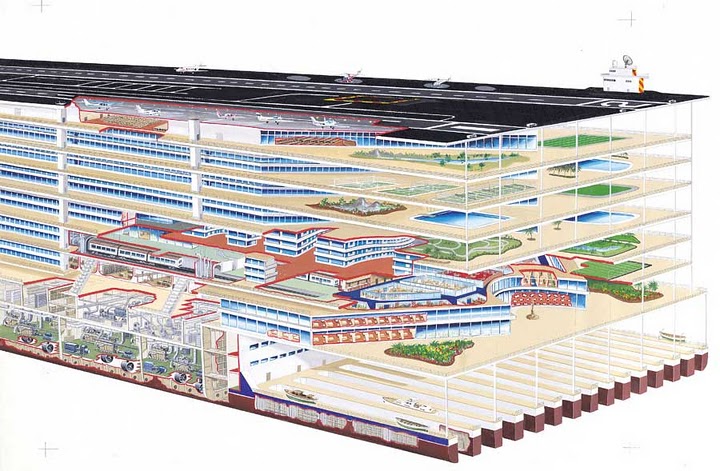
No cruise ship that has ever been built can compare to the enormity of Freedom Ship. Imagine a mile-long stretch of 25-story-tall buildings in New York City; now imagine that floating on the water. If you can picture that, then you get the­ general idea of Freedom Ship's size. At 4,320 feet (1,317 meters) long, 725 feet (221 m) wide and 340 feet (103 m) tall, the ship is taller than the length of a football field and wider than two football fields put together. And not only can a ship that size float on water, but it may be navigating the world's oceans as early as 2005.

Freedom Ship will dwarf any ocean-going vessel operating today -- it will be more than four times longer than any current cruise ship.


This is ship Freedom, dream yacht futuristik which might possibly will become reality. Possibly You have ever seen conspecific illustration in medias iptek or scientific publications outside there. With all technological advanceses in century 21 likely nothing that not possibly to realized.


Freedom Ship will be built on top of 520 airtight steel cells that will be bolted together to form a sturdy base. Each cell will be 80 feet (24 meters) tall, between 50 and 100 feet (15 and 30 m) wide and between 50 and 120 feet (15 and 37 m) long. These cells will be assembled to form larger units that are about 300 x 400 feet (91 x 122 m). These larger units will then be taken out to sea, where they will be put together to form the ship's nearly mile-long base. The rest of the ship will be constructed on top of this base. Norman Nixon, who developed the idea of a floating city, has said that it will take about three years to finish the ship once construction begins.

It will take a tremendous amount of engine power to push the gigantic ship through the water. The vessel will be equipped with 100 diesel engines that can generate 3,700 horsepower each. Developers project the cost of each engine to be about $1 million. That may give you an idea of how expensive the project is, although the total cost of Freedom Ship has not been released. The ship's high construction cost will be passed on to residents, who will pay up to $11 million to purchase living space on the floating city. In the next section, you'll find out what these residents will get for such a price.

Source : howstuffworks.com

Thursday, January 20, 2011

Seven Businesses You Can Start Tomorrow

When her husband lost his job in 2002, Christine DeLuca rented out two of the beds in their Woodstock, Vt., home. She ran the makeshift bed and breakfast (and ate into their savings) for a few years before upgrading to a larger house on a farm in nearby Quechee. Open on weekends since August, the Inn at Clearwater Pond, with four rooms and an adjoining cottage, has pulled in roughly $8,000 a month in revenue.
 
 "I didn't know a thing about running a bed and breakfast," says DeLuca. "But [it] came very naturally to me because I love to entertain and have people in my home." DeLuca aims to triple those revenues by operating at full capacity (the Inn is at 50% now) and having guests during the week.
 
 You don't need a fancy pedigree or specialized set of skills to launch a business. Some start-ups require more capital than others, of course, and all companies demand care and feeding. But if you can muster the courage, do a bit of research and secure a tax identification number (so Uncle Sam can take his cut), you can be your own boss.
 
 Low-tech ventures that work best tend to target a devoted customer base and offer an easy-to-grasp product or service. Take dog walking (as in, walking dogs).
 
 A former Unisys call center representative who went back to college in his late 30s, Kevin Meadows started walking dogs part-time while attending St. Edwards University in Austin, Texas. A friend told him about a stockbroker in San Francisco who quit his job to start a dog-walking service. Rumor had it the guy made six figures carting dogs on a flat-bed truck to a park so they could run around for a few hours a day.

 Now 41, Meadows hasn't bought a flat-bed, but he's making money. Austin Dog Walkers handles 20 to 30 pooches a day; Meadows piles six in his sport utility vehicle and the rest go with two other walkers, each of whom cover a specific part of the city. Daily revenues: about $450. Out of that, Meadows pays his two contractors 80% of the revenue they generate. Gas eats up $700 to $800 a month, but advertising costs are minimal--though Meadows did take a course in animal first aid. "Anything you can do to give people confidence that you're trustworthy is important," he says. Estimated pretax income this year: about $60,000.
 
 Keri Cooper, a corporate-event manager in Seattle, went after another fanatical group of customers: anxious brides and grooms (and the parents who write the checks). "I was doing some soul searching, so I just started coordinating a few weddings on the side," she says.
 
 The demand for these services is breathtaking. Wedding consultants charge $1,000 to $20,000 per event, depending on location and breadth of services. The best clear $100,000 a year.
 
 To drum up business, Cooper mails clients a formal, mock wedding invitation when she schedules an introductory meeting. She now coordinates 20 weddings per year. "More than that and I can’t give enough time to my clients," she says. Cooper charges between $1,600 and $10,000 per event. Three-year-old company Bliss Events now nets between $40,000 and $70,000 a year.
 
 While a business may look quick and easy to start, profits might be a long time coming. Just ask Kimberly Raymond, who decided a year ago to quit her soul-sapping sales job to start her own personal concierge service in Washington, D.C.
 
 "I got started in day--I'm not kidding," she says. "I decided on a bike ride that [this] was the right idea. Instead of heading home, I turned around and went over to my friend's house. She became my first client."
 
 To her credit, Raymond chose a growing industry. "Everybody is trying to squeeze 36 hours into a 24 hour day," says Katherine Giovanni, founder of International Concierge and Errand Association, which has 600 members in 20 countries, up from 20 members a decade ago.
 
 But Raymond's hair-pin turn brought pain. While start-up costs were minimal--Web site design (a few hundred bucks), accountant ($400), fliers and business cards ($200), her new business is still under water. After 13 months, Raymond's 12 clients have only yielded $25,000 in revenues--far short of her $33,000 in living expenses. She fills the gap, in part, with $5,000 in credit card debt, now at a low 10% interest rate.
 
 "It's been a really challenging year, financially," she says. "I'm thinking of spinning off into event management."


1. Personal Concierge

       A personal concierge handles "anything in the Yellow Pages as long as it's legal, moral and ethical," says Katharine Giovanni, founder of the International Concierge and Errand Association, now with 600 dues-paying members in 20 countries. Some established concierges act as general contractors who hire and manage a host of services, from cleaning to shopping.
   Start-up costs: Minimal--other than basic liability insurance, perhaps a few hundred dollars per year.
   Income: Dollars vary drastically depending on the client base, though six-figure incomes are not unheard of, says Giovanni.
   Tip: Build a network of dependable vendors before you tackle bigger, more demanding clients.
...
2. Dog Walking
       Yes, you can make a living cavorting with canines--it just takes a little scale, transportation and only a mild distaste for waste.
  Start-up costs: A few leashes, some chew toys and maybe a vehicle, and you're ready to go. You'll also want a Web site and some insurance. One problem: Gas over $3 a gallon will sting walkers who round up their customers in sprawling suburbs.
  Income: Depends on pricing and the number of dogs you can handle. Kevin Meadows, owner of Austin Dog Walkers, handles between 20 and 30 dogs a day. Annual pretax profits: about $60,000.
   Tip: Take an animal first-aid course or volunteer at a shelter--if only to convince clients that they should trust you with their prized pets.
....
3. Wedding Consultant
      You won't find a more fanatical customer base than anxious brides, grooms and the parents writing the checks. Some consultants coordinate everything from scratch, while other parachute in on the big day to make sure things run smoothly.
  Start-up and ongoing costs: All you need to get going is a phone, an Internet connection (for researching vendors) and a lot of patience. Consider advertising on wedding Web sites like TheKnot.com and WeddingChannel.com. Bridal trade shows cost as much as $5,000 per booth.
  Income: Consultants charge $1,000 to $20,000 per event, depending on location and breadth of services. The best clear $100,000 a year.
  Tip: Focus on the visual. Kerri Cooper, owner of Seattle-based Bliss Events, mails clients a formal, mock-wedding invitation when scheduling an introductory meeting.
....
4. Vending Machine Operator
      Install the machines and let the masses snack to their hearts' discontent.
  Start-up costs: Between $2,000 and $3,000 apiece for new machines. Check out www.vending.org
  Income: A typical "45 Select" machine carrying 45 snacks (10 to 20 of each) generates $5,200 to $7,800 in annual sales; operators might keep 25% of that. In general, schools and hotels are the best locations. And don't forget maintenance. "Half the battle with these machines is keeping them in working order," says Lori Endres, owner of S & L Vending, an operator in Phoenix.
  Tip: The more machines you own, the better pricing you'll get from vendors. Note: Beware "blue sky" operators leasing machines at usurious rates.
...
5. Innkeeper
      This one demands a bit of up-front capital, but not much more. Buy an existing business or rent out extra rooms in your house. In either case, you'll be handling the cleaning and cooking (breakfast, mostly). You'll also want to know something about the surrounding area to guide guests from out of town.
  Start-up and ongoing costs: After liability insurance, you'll need duplicate sets of linens, towels, dishes and silverware for all rooms. Ongoing expenses include gas, water, heating, food and cleaning (if you don't feel like doing that yourself).
 Income: Inns charge anywhere from $100 to $400 per room per day, depending on the location, amenities and season.
  Tip: Run the largest inn you can afford--there is operating scale here.
...
6. Laundromat
      Unlike a dry-cleaner, you don't need to understand the art of stain removal to run a coin-operated laundromat. Nor do you have to spend all day at the office.
  Start-up costs: Existing laundromats sell for up to several hundred thousand dollars, depending on location. Heavy-duty washers that can handle 50 to 75 pounds of clothes (four to eight typical home loads) cost up to $5,000 apiece; dryers, maybe $3,000. Maytag, Whirlpool and Speed Queen each have local distributors.
  Income: Depends on the number of machines and how often they run. A 50-pound capacity washer will bring in up to around $7.50 per cycle (15 cents per pound of clothes); a 25-pounder, about $3. A busy laundromat can keep its machines running 30% of the time. Typical operating margins: 20% to 30%.
  Tip: Downtime is a killer, so have competent maintenance people at the ready.
..
8. Nightclub Promoter
      Socialites on steroids might like this gig, which involves rounding up partiers to drink and dance at local hotspots. And with all those viral social networking sites, you don't even need a big Rolodex to start.
  Start-up costs: Mainly your time. Work everybody--the doorman, wait staff and possibly the club owner--to land your first gig, says Noah Tepperberg, the owner of Marquee nightclub in New York City.
  Income: Promoters get paid a flat rate or on a commission basis, depending on the number of people they bring in. Snag a high-roller and you might even get a percentage of what he or she spends. The best promoters in New York City pull in a few thousand dollars in one night.
  Tip: It's easy to get ripped off in this business. Work only with club owners you trust.
...

Wrote by Maureen Farrell

Amazing Mazu Gold

"About 9 months ago I had to get a x-ray of my hip because I was in a lot of discomfort and had trouble walking. When I went to my Rheumatologist for the results she said I had deep issues in the bone of the hip. The remedy they wanted me to take was a prescription which I was not happy about. I only took a 4 pack sample from her office and only took two of the pills because of side effects and I told my doctor I did not want to take drugs for this. During this time I was on a product from another nutrition company that was said to have beaten prescriptions in double blind clinical trials. Another product from a MLM company that was the top Glutathione nutritional on the market . A zero point energy wand from another MLM company all with little results.

 I was lucky enough to receive a call from a good friend and he introduced me to MazuGold , after one week on the product the pain in my hip is gone. I have energy like I had when I was in my twenties."
Ed B, New York.


 that is a nonfiction about greatness Mazu Gold.

Mazu Gold is one of product from mazu global having 16 patent rights international.

 In Fact, Mazu Gold have Nutritions :
  • Absorbanol     : 1405mg
  • Calories          : 17
  • Carbohydrates: 3g
  • Sugars            : 3g
  • Fat                 : 0g
  • Vitamin c        : 3mg
  • Vitamin B-2    : 0.44mg
  • Vitamin B-3    : 10.5mg
  • Vitamin B-5    : 3.3mg
  • Vitamin B-6    : 0.66mg
  • Vitamin B-12  : 60mcg
  • Sodium           : 10mg
Mazu Gold recommended use : 1 to 2 ounces twice daily

I cannot study farther about mazu gold, but Mazu has business opportunity for you with a real commission promises and best support.

for details you can visit Mazu

Wednesday, January 19, 2011

Future Flight - The Next 100 Years

NASA recently presents its(the concept about future aeroplane, bigger, more efficient, and a few looked to be odd, but still not as odd and makes is vexed like other concepts, including here nuclear energetic planes and airport in atmosphere.


this NASA Concept based on design scramjet, and possibly will become reality of during 20 years which will come. But remain to only, some in drawing that is a few looked to be too are optimistic.

This drawings might possibly will be realized, which according to Max Kingsley-Jones from Flight's Global in his (its editorial, has just at air transport in 100 years which will come.

Flight's first editor Stanley Spooner had little trouble deciding what story would be the lead in our inaugural issue 100 years ago - "A Second Englishman Flies" was our first headline. But back in those pioneering early days, what would Spooner have predicted for the top aerospace story a century later?

Even the most enthusiastic aeronauts and aviators in 1909 would have struggled to believe the way in which powered flight would evolve during the magazine's first 100 years: that the aeroplane would be "going to war" within five years that passengers would be travelling in shirtsleeve comfort across the Atlantic at twice the speed of sound within 70 years or that within 80 years a winged spaceplane would be regularly blasting into orbit and returning to earth as a glider.


There are some fundamental questions that must be answered when examining likely scenarios 50 to 100 years from now: how much oil will be left and how much will it cost? Will the green lobby - and any increasing evidence of serious climate change - have forced the way we travel by air to have to be reinvented? How will the threats to world security/peace influence military aircraft design? And how much of the space exploration dream will have become a reality?

CONSOLIDATION DRIVER

The driver for new airliners will be the shape of the industry that flies them. If today's drive for consolidation through alliances and mergers is allowed to run its course (assuming the regulatory environment is adjusted to permit it), then there could end up being just three major airline groups - perhaps one for each continent - "America Air", "Europe Air" and "Asia Air" - or three international global network carriers slugging it out through hubs in Europe, the Gulf and South-East Asia.

Extreme scenarios at each end could see passengers either travelling in ultra-fast and ultra-green jets, or facing a strict rationing of flying because of environmental concerns. The latter could also result in competition being eliminated and route duplication outlawed.


A European future-aviation think-tank, dubbed Out of the Box, is evaluating various "far-out ideas" that could address environmental concerns and enable the airline business as we know it to be sustained. By adopting ground-based power sources for take-off and landing, the aircraft's installed power and systems could be reduced with direct benefit to fuel consumption and weight. Ideas to propel the aircraft aloft include electrical, steam or magnetic devices using oil-based, nuclear or solar energy sources. For landing, aircraft weight could be reduced by eliminating the undercarriage with landings on water or on small cars using electro-magnetic fields to position the aircraft.

Out of the Box also envisages large "cruiser" airliners, possibly nuclear-powered, remaining airborne almost indefinitely flying on circular routes connecting major population centres. Short-range shuttle aircraft would intercept the cruisers and land on or dock for the transfer of passengers and freight.

NASA is gearing its research effort to deliver novel solutions within three aircraft development generations. It has awarded 18-month study research contracts to six industry teams to study advanced concepts for subsonic and supersonic airliners with advanced airframes and propulsion systems.

Dubbed N+3, the concepts should be three generations beyond the current commercial transport fleet that could enter service in 25 to 30 years and able to overcome significant performance and environmental challenges.

AIR TRAFFIC MANAGEMENT

Of course a vital element of future air transport will be a restructuring of air traffic management. While a globalised and seamless air traffic system might seem an unachievable dream, it has to be a target. The ongoing effort to create a "Single European Sky" should represent only the beginning, with new technology allowing a high degree of autonomy to enable individual aircraft make their own way through controlled airspace. Could this ultimately lead to pilotless airliners? Some airline chief executives would surely hope so.

The humans that get to keep their place at the controls can expect continuous improvements in the technology at their fingertips, even if the cockpit layout itself becomes much simpler thanks to greater automation. An obvious development would be for the head-up display to become standard, providing navigation data combined with synthetic and enhanced vision, while voice recognition will take care of switch inputs. Meanwhile, increasing automation of flight controls will see the pilot with less manual involvement in the flying - and taxiing - which should lead to an improvement in safety.

Ever-improving surveillance capability will enable satellite-based and real-time four-dimensional operations with constant dataflow between the air and the ground - the latter having the option to take control in an emergency. Such developments would pave the way for single-pilot operations of freighters and other non-passenger carrying flights.

ENGINE TARGETS

The development of engines in the near term will be targeted at lower fuel consumption and emissions, although achieving this in parallel with further significant noise reductions will be a challenge. Geared turbofans, advanced turbofans and open rotors may hold the answer in the shorter term, while efficiency could be improved through recuperation where heat energy is taken from the hot section.

But a clean-sheet approach to power will be needed eventually. The diminishing availability of oil will drive the development of engines compatible with non-fossil-based fuels - for example engines that are capable of direct burning of gaseous or liquid hydrogen derived from water.

Future engines could see on-board power generated directly from their shafts using electromagnets, eliminating the need for an accessory gearbox. However, in the medium term, fuel cells are more likely to provide an answer in the drive to reduce reliance on engines for all on-board power.

As part of the effort to reduce aircraft weight and boost efficiency, the more-electric concept will see electric actuators replace hydraulic systems throughout the airframe.

The JSF will make fifth-generation fighters a reality when it enters service in 2013, but it will still have a little pink body sat at the sharp end controlling it. The US Air Force is working on an "interim" next-generation bomber to augment the B-1B, B-2 and geriatric B-52, which will be also manned. This is notionally aimed for a 2018 debut, but it is more likely to arrive some time in the early 2020s.

As the successors to the Pentagon's original "black jet", the F-117A, the Raptor and F-35 represent the latest interpretation of stealth technology. Where this will go next is unclear - could the technology extend to areas like visual stealth, enabling the creation of 007-style "invisible" helicopters?

While no successor to the F-35 has yet been formally discussed, both the USAF and the US Navy have started talking about a "sixth-generation fighter" to replace F-15s and F/A-18s, starting around 2025. This could be a pilot­less concept, taking the shape of an unmanned combat air vehicle like the Boeing X-45 or Northrop Grumman X-47, or a more conventional piloted design, for example a development of the F-22.

If the unmanned route is followed, could this ultimately lead to an autonomous aircraft controlled by an on-board computer that can mimic human cognitive reasoning? If that sounds too far-fetched, then perhaps at least consider that the stores the UCAV carries will be "intelligent munitions" with independent "loiter, search and destroy" capability.

RADICAL BOMBER

A more radical bomber design beyond the interim plan is proposed for 2037. So far there have been few clues on how it will be controlled and what it will look like, although hypersonic performance is clearly among the candidate capabilities.

At the other extreme, work is intensifying on the development of tiny "nano-technology" aircraft that can fly surveillance missions undetected to previously inaccessible locations. Lockheed Martin is already working on a remote-controlled nano air vehicle design under a $1.7 million contract from the US Department of Defense's DARPA research arm.

Beyond the horizon, military concepts could close the gap to spacecraft designs - as they did in the "Right Stuff" era of the X-15 back in the 1960s - leading to the creation of aircraft with hypersonic performance capable of sub-orbital flights. Such aircraft could use air-breathing hypersonic-cruise engines - possibly of all-composite structure - although such performance and technology is more likely to find an initial application on the next generation of air-launched missiles.

Back in the last century, the dawn of space weaponisation came close with US President Ronald Reagan's "Star Wars" plan. The prospect of such capability arriving in the next 100 years must be considered strong, perhaps in the form of a "directed-energy" weapon like a particle beam or laser - pure science fiction or future science fact?

In the military support arena, there may be some radical ideas for mega transports to succeed aircraft like the C-5 Galaxy in the troop transport role. These could take the form of huge blimps or aircraft - for example, a blended wing body design - capable of transporting hundreds of troops and their vehicles and equipment.

General aviation - as we would define it today - was where powered flight originated early in the 20th century, and the next 100 years should see increasing numbers of people being able to enjoy the pleasure of "personal aviation", thanks to the ever greater availability of small, inexpensive and flexible aircraft.

Flying cars transporting people along dedicated "highways in the sky" at low cost on high-volume routes similar to the railway networks operated today, could be the answer to growing road congestion. The new generation of very light and personal jets will become an increasingly viable alternative to the strict regime of commercial flying, at a fraction of the cost of today's business jets. This could fuel the growth of air taxi operations, which would become an integral part of the transport system and open remote and formerly inaccessible areas to businesses and individuals.

At the top end of the market supersonic business travel could become the norm for high net worth customers, as all the major corporate jet airframers develop designs capable of long range and very fast cruise speeds beyond the speed of sound.

Given that the space age was two years old when Flight celebrated its 50th anniversary in 1959, at that time our team of journalists could have been forgiven for making some quite ambitious predictions for interplanetary achievements through the next half century. But the reality has been that after a momentous start - man walked on the Moon the year we reached our 60th birthday - they would probably have expected much more than we have achieved since then.

Having made spaceplanes a reality in 1981 with the Space Shuttle, NASA has decided to return to Apollo technology for its replacement. Sir Richard Branson's efforts apart - he aims to operate his first Virgin Galactic space tourism flights this year - further progress in manned spaceflight will depend on what US president-elect Obama decides to do once he reaches office.

Among the decisions to be made are how and whether to continue with plans to return to the Moon - could an international lunar outpost become a reality in the next 20 years.

The International Space Station is likely to see another decade of service before it is de-orbited. Will its replacement - or the lunar outpost - be built with as much emphasis on commercial tourist flights as on scientific research? And could a manned mission to Mars be nearing reality by the middle of the century?

Longer-term space exploration will depend much on new propulsion technology, such as nuclear-electric "plasma" engines (also known as impulse drives) that could power robotic missions to the outer planets in the solar system. Using fission systems as their basis, such engines could reduce the travel time between Earth and Mars from the six months envisaged.

NEW ROCKET TECHNOLOGY


The xenon gas-powered plasma thrusters used on the latest satellites and interplanetary probes will gain increased power and specific impulse durations as their power source changes from today's solar panels to a simple nuclear device using the heat from a radioactive material, and eventually a fission nuclear reactor. New rocket technology to place spacecraft into orbit will see the slow phasing out of hypergolic propellants and replacement by a liquid oxygen/kerosene for the main engines (or LOx/liquid hydrogen where higher specific impulse is needed).

And lurking in the background throughout all this development will be the possibility that NASA and its partners may one day be called upon to develop a robotic mission to divert an asteroid on a collision course with Earth.

Much of these thoughts for the next 100 years of Flight may appear to be little more than science fiction. But then the same would have been true of the aviation feats that became realities during our first century, to the readers who picked up our inaugural issue in January 1909.

Source : www.flightglobal.com

Tuesday, January 18, 2011

Eco-city, Town in Crater

This town will be built in crater made in man. Its(the concept eco-city, environmental friendliness and applied as new industry zone in Russia.


AB ELISE, architecture design housing of Russia, has developed project of ysg called as Eco-city 2020, what addressed as rehalitasi industrial zone in town Mirny, Yakutia. this Eco-city will be built in artificial crater having diameter around 1 kilometre with depth of 550 meter.

Crater made in this it is possible that is the biggest dig aperture in second world. This dig will be closed over by glass arch. This eco-city area wide total reachs 2 million square meters, ready to accommodate 100000.


The its(the architects hopes " garden city" this will become landmark in Siberia Timur. Even its(the design have been finished, the existing finite of its(the development still have not heard in Yakutia.